Data Model
Table of contents
Overview
EORSA-DB organizes Earth Observation data around a hierarchical domain model. The diagram below shows the main entities and their relationships.
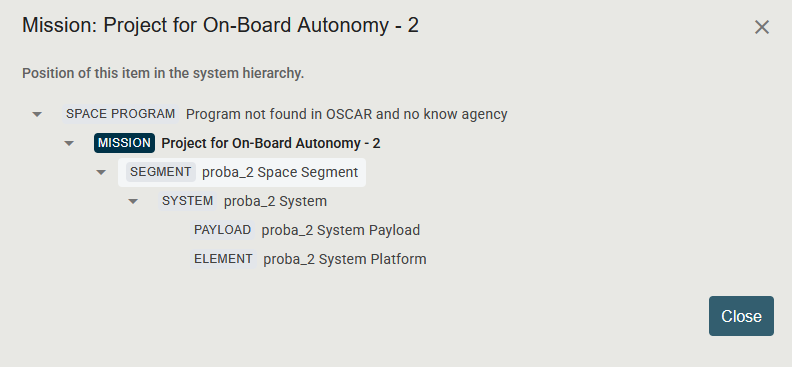
Entity Hierarchy
The core data model follows this containment hierarchy:
Space Programme
├── Mission (1..*)
│   ├── Segment (1..*) ──── [Space | Launch | Ground]
│   │   └── System (1..*)
│   │       ├── Payload (Instrument) (0..*)
│   │       │   ├── Child Payloads (0..*)
│   │       │   ├── Equipment (0..*)
│   │       │   ├── SubSystem (0..*)
│   │       │   └── Spectral Bands (0..*)
│   │       ├── Platform (0..*)
│   │       │   ├── Equipment (0..*)
│   │       │   └── SubSystem (0..*)
│   │       └── Orbit Parameters
│   ├── Mission Phase (1..*)
│   │   └── Milestone (0..*)
│   ├── Data Product (0..*)
│   │   └── Essential Climate Variable (0..*)
│   ├── Auxiliary Product (0..*)
│   └── Requirement Specification (0..*)
│       └── Requirement Group (0..*)
│           ├── Requirement (0..*)
│           └── ECV Requirement (0..*)
│               └── Parametric Constraint (0..*)
├── Project (0..*)
│   └── Project Phase (0..*)
└── Organisation (0..*)
Key Relationships
Space Programme → Mission
A Space Programme is the top-level grouping entity. Each Programme contains one or more Missions and optionally Projects. Examples of Programmes include ESA’s Earth Explorer programme or Copernicus.
| From | Relationship | To | Cardinality |
|---|---|---|---|
| Space Programme | contains | Mission | 1..* |
| Space Programme | contains | Project | 0..* |
| Space Programme | involves | Organisation | 0..* |
Mission → Segment → System
A Mission is decomposed into Segments that represent major functional areas:
- Space Segment: Satellites and orbital elements
- Launch Segment: Launch vehicles and infrastructure
- Ground Segment: Ground stations and data processing facilities
Each Segment contains one or more Systems, which are the top-level assemblages (e.g., a specific satellite).
| From | Relationship | To | Cardinality |
|---|---|---|---|
| Mission | decomposes into | Segment | 1..* |
| Segment | contains | System | 1..* |
| System | has | Orbit Parameters | 1 |
| System | active during | Mission Phase | 0..* |
System → Payload (Instrument) and Platform
Each System contains Elements, which can be either a Payload (instrument/sensor) or a Platform (spacecraft bus providing power, communications, navigation).
Payloads can be hierarchically nested — a Payload may contain child Payloads — and they define the Spectral Bands they cover.
Both Payloads and Platforms contain Equipment and SubSystems.
| From | Relationship | To | Cardinality |
|---|---|---|---|
| System | contains | Payload | 0..* |
| System | contains | Platform | 0..* |
| Payload | contains | Child Payload | 0..* (hierarchical) |
| Payload | has | Spectral Band | 0..* |
| Payload / Platform | contains | Equipment | 0..* |
| Payload / Platform | contains | SubSystem | 0..* |
| Equipment | contains | Child Equipment | 0..* (hierarchical) |
Mission → Data Product → ECV
Data Products represent the geophysical measurements produced by a Mission’s instruments. They have a processing level (L1, L2, L3, etc.) and are linked to the Equipment that measures them.
Data Products contribute to Essential Climate Variables (ECVs), which represent the physical, chemical, or biological variables relevant to characterizing Earth’s climate.
| From | Relationship | To | Cardinality |
|---|---|---|---|
| Mission | produces | Data Product | 0..* |
| Data Product | measured by | Equipment | 0..* |
| Data Product | contributes to | Essential Climate Variable | 0..* |
| Data Product | supported by | Auxiliary Product | 0..* |
| Mission | has | Auxiliary Product | 0..* |
Project and Programme
Projects represent coordinated activity sets with defined start and end dates. They exist within a Space Programme and may be linked to multiple Missions.
| From | Relationship | To | Cardinality |
|---|---|---|---|
| Space Programme | contains | Project | 0..* |
| Project | involves | Mission | 0..* |
| Project | has lifecycle | Project Phase | 0..* |
Requirements Hierarchy
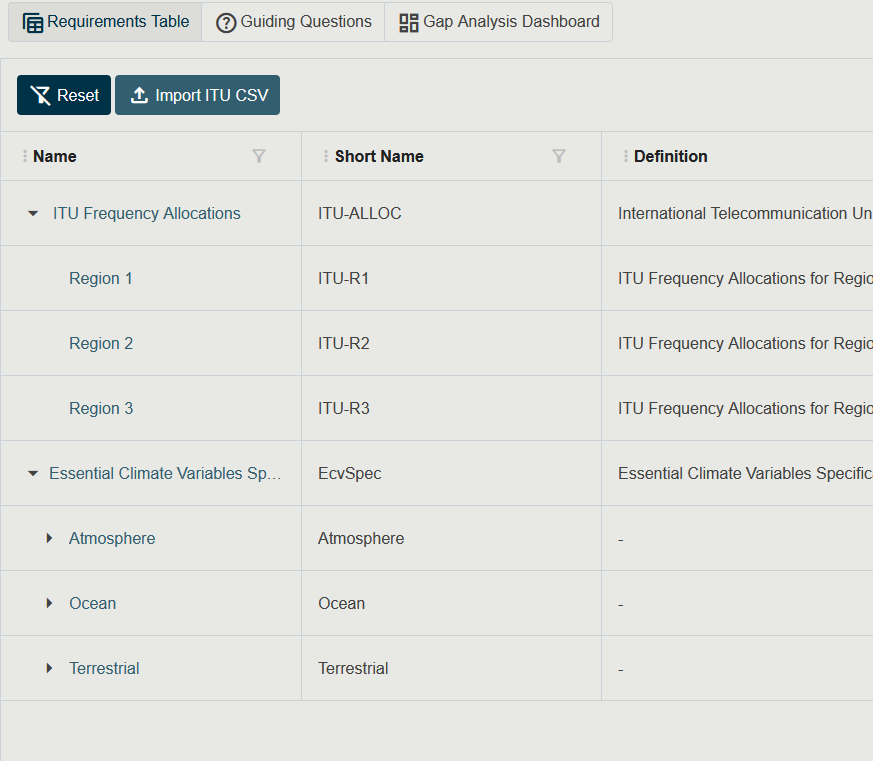
Requirements in EORSA-DB follow a three-level hierarchy:
- Requirement Specification: The top-level document (e.g., a Mission Requirements Document), owned by a Mission.
- Requirement Group: A section or chapter within a specification. Groups can contain sub-groups.
- Requirement: An individual verifiable condition. Requirements may have Parametric Constraints — boolean expressions evaluated against parameter values.
ECV Requirements are a specialised type of Requirement used for Essential Climate Variable compliance checking.
| From | Relationship | To | Cardinality |
|---|---|---|---|
| Mission | has | Requirement Specification | 0..* |
| Requirement Specification | contains | Requirement Group | 0..* |
| Requirement Group | contains | Requirement | 0..* |
| Requirement Group | contains | ECV Requirement | 0..* |
| Requirement | has | Parametric Constraint | 0..* |
Categories and Parameter Values
Categories form an acyclic hierarchy (via Super Categories) and can be assigned to most entities. Each Category defines Permissible Classes that control which entity types it can be applied to.
Parameter Values can be assigned to any categorizable entity. Each value is typed by a Parameter Type which determines the allowed data format (boolean, date, text, enumeration, quantity, etc.).
| From | Relationship | To | Cardinality |
|---|---|---|---|
| Category | has super | Category | 0..* (acyclic) |
| Category | defines | Permissible Class | 1..* |
| Any categorizable entity | classified by | Category | 0..* |
| Any parameterizable entity | has | Parameter Value | 0..* |
| Parameter Value | typed by | Parameter Type | 1 |
Inheritance Model
All entities in EORSA-DB inherit from a common base:
IThing (root — has Iid, RevisionNumber, ClassKind)
├── IDefinedThing (adds Name, Definition, Attachments, Images, DataSource)
│   ├── ICategorizableThing (adds Category list, Permissible Classes)
│   │   └── ISimpleParameterizableThing (adds DataType, Parameter Values, Financial Transactions)
│   │       ├── Mission
│   │       ├── Project
│   │       ├── Segment
│   │       ├── Mission Phase
│   │       ├── Project Phase
│   │       ├── Space Programme
│   │       ├── Organisation
│   │       ├── Data Product
│   │       ├── Payload
│   │       ├── Platform
│   │       ├── Equipment
│   │       ├── System
│   │       └── Requirement
│   └── IParameterType (abstract — adds Symbol, NumberOfValues)
│       ├── Scalar Parameter Type
│       │   └── Boolean Parameter Type
│       └── Compound Parameter Type
│           └── Array Parameter Type
└── IRequirementsContainer
    └── Essential Climate Variable
This means all domain entities share common properties like Name, Definition, Categories, Parameter Values, and Attachments.