Data Model Relationships
Table of contents
Overview
EORSA-DB organises all Earth Observation information around a central data model. This page explains the key entities and how they relate to each other. Understanding these relationships is important for navigating the application, interpreting dashboards, and attaching data at the correct level of the hierarchy.
Show in Structure
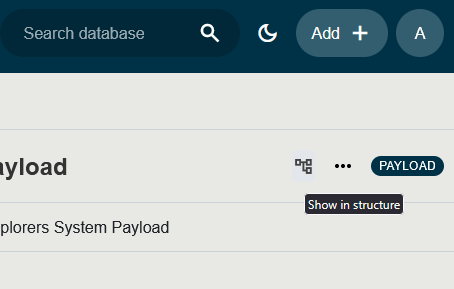
When you are looking at a detail page (for example a Payload or a Sub-System), it is not always obvious where that item sits in the larger Mission Hierarchy. To see it in context, click the product_tree icon button at the top of the detail page (its tooltip reads Show in structure).
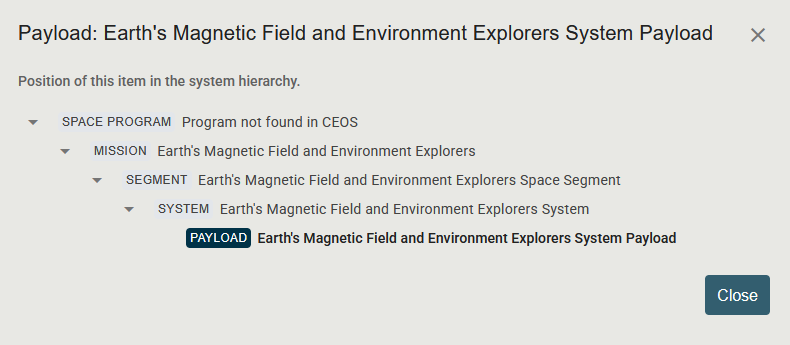
A dialog opens titled Position of this item in the system hierarchy and shows the full parent-to-child path, with the current item highlighted. Click Close to return to the detail page.
The Mission Hierarchy
Space Program
A Space Program is the top-level grouping. It represents a programme or initiative under which one or more missions are developed (e.g., Copernicus, ESA Earth Explorers, EUMETSAT METOP).
- Contains one or more Missions.
Mission
A Mission represents an individual space mission. It belongs to a Space Program and has a defined lifecycle (start date, end date).
A Mission contains:
- One or more Segments (Space, Ground, Launch)
- One or more Data Products
- One or more Auxiliary Products
- One or more Mission Phases (development, launch, nominal, extended, …)
- One or more Requirement Specifications
Segment
A Segment is a major subsection of a Mission. The SegmentType property classifies it as:
| SegmentType | Description |
|---|---|
| Space | The satellite or constellation of satellites. |
| Ground | Control/reception stations and infrastructure. |
| Launch | The launch vehicle and associated services. |
A Segment contains one or more Systems.
System
A System is a single physical entity within a Segment — an individual satellite, a ground station, or a launch vehicle. Systems have:
- An optional Two-Line Element (TLE) record (orbital data — see TLE)
- Optional Orbit Parameters (altitude, inclination, period, …)
- Optional Start Date and End Date
- One or more Mission Phases linkages
- One or more Elements (Payloads and Platforms)
Element — Payload and Platform
An Element is a sub-unit of a System. There are two types:
| Type | Description |
|---|---|
| Payload | A scientific instrument or sensor. Carries Spectral Bands and is linked to Data Products. Can have child Payloads (hierarchical instrument decomposition). |
| Platform | The spacecraft bus or ground infrastructure supporting the Payload. Contains Sub-Systems. |
A Payload can have:
- Child Payloads (nested instrument hierarchy)
- Spectral Bands — frequency/wavelength ranges (see Spectral Bands)
- Links to Data Products via the
MeasuredByEquipmentrelationship on DataProduct
Sub-System
A Sub-System is a technical component of a Payload or Platform (e.g., power supply, thermal control, data handling unit). Sub-Systems are the lowest level in the mission hierarchy.
Scientific Data Relationships
Data Product
A Data Product is a scientific output of a Mission. It is processed from raw instrument data into a usable format.
- Belongs to a Mission
- Has a Data Product Level (raw, Level-0, Level-1, Level-2, …)
- Is Measured By one or more Equipment (Payloads) via the
MeasuredByEquipmentlink - Is linked to one or more Essential Climate Variables (ECVs) it contributes to
- Is linked to one or more ECV Requirements it is designed to meet
Essential Climate Variable (ECV)
An ECV is a variable defined by GCOS (Global Climate Observing System) as essential for understanding and monitoring the climate system (e.g., Sea Surface Temperature, Soil Moisture, Ozone).
- ECVs are linked from Data Products and from ECV Requirements in Requirement Specifications
- The Gap Analysis Dashboard shows which ECVs are currently covered by active missions
Requirement Specification
A Requirement Specification is a formal requirements document associated with a Mission. Requirements are structured hierarchically:
RequirementSpecification
└── Requirement Group
    └── Requirement
        └── ECV Requirement  (with ParametricConstraints)
ECV Requirements express the specific measurement needs for a given ECV, including accuracy, resolution, and revisit time constraints.
Financial Relationships
Financial Transaction
A Financial Transaction is a cost or income record that can be attached to any entity in the hierarchy (Mission, Segment, System, Element, Sub-System, …) via the BelongsToThing property.
Key relationships:
| Property | Links To | Description |
|---|---|---|
BelongsToThing | Any entity | The entity this transaction is attached to. |
CurrencyUnit | Currency | The currency in which the value is expressed. |
ReferenceEconomicCondition | Economic Condition | The reference year’s economic context for the recorded value. |
Country | Country code | Country of origin of the transaction. |
Economic Condition
An Economic Condition is a reference-year record that stores the year and the annual percentage change in economic conditions (inflation factor). It is used to normalise financial values across years. See Economic Conditions.
Currency
A Currency defines a monetary unit (e.g., EUR, USD, GBP). Currencies are managed in the Administration application.
Organisational Relationships
Organisation
An Organisation (space agency, company, consortium) can be linked to a Mission through contract or participation roles. Organisations appear in the Geographical view of the Financial application as countries contributing to the mission.
Project
A Project is an optional management grouping that can link to both a Space Program and one or more Missions. It provides a programme-management layer above individual missions.
Relationship Quick-Reference
| From | Relationship | To |
|---|---|---|
| Space Program | has many | Missions |
| Mission | has many | Segments |
| Mission | has many | Data Products |
| Mission | has many | Mission Phases |
| Mission | has many | Requirement Specifications |
| Segment | has many | Systems |
| System | has 0..1 | Two-Line Element |
| System | has many | Elements (Payloads, Platforms) |
| Payload | has many | Spectral Bands |
| Payload | may have many | Child Payloads |
| Platform | has many | Sub-Systems |
| Data Product | measured by many | Payloads (Equipment) |
| Data Product | linked to many | ECVs |
| Requirement Specification | has many | ECV Requirements |
| Financial Transaction | belongs to | Any entity |
| Financial Transaction | references | Economic Condition |
| Organisation | participates in | Mission |